
Fock state
Definition:
A Fock state is a quantum state that contains a precise number of non-interacting, identical particles, such as photons or atoms, in a given mode or energy level.
Scientific context:
Fock states are fundamental to quantum optics and quantum field theory. They are the eigenstates of the number operator, meaning the number of particles in the state is well-defined and not subject to uncertainty. In contrast to coherent or thermal states, Fock states exhibit no fluctuations in particle number, making them useful for applications requiring high precision, such as quantum metrology, quantum information processing, and single-photon experiments.
Example in practice:
A single-photon source generates a Fock state, which is essential for protocols like Quantum Key Distribution (QKD). Unlike laser light (which is a coherent state), a true single-photon Fock state ensures that no extra photons are emitted, preventing certain eavesdropping attacks based on multi-photon pulses.
Did you know?
The concept of Fock states is named after Soviet physicist Vladimir Fock, who introduced them in the context of quantum harmonic oscillators and many-body systems.
Media:
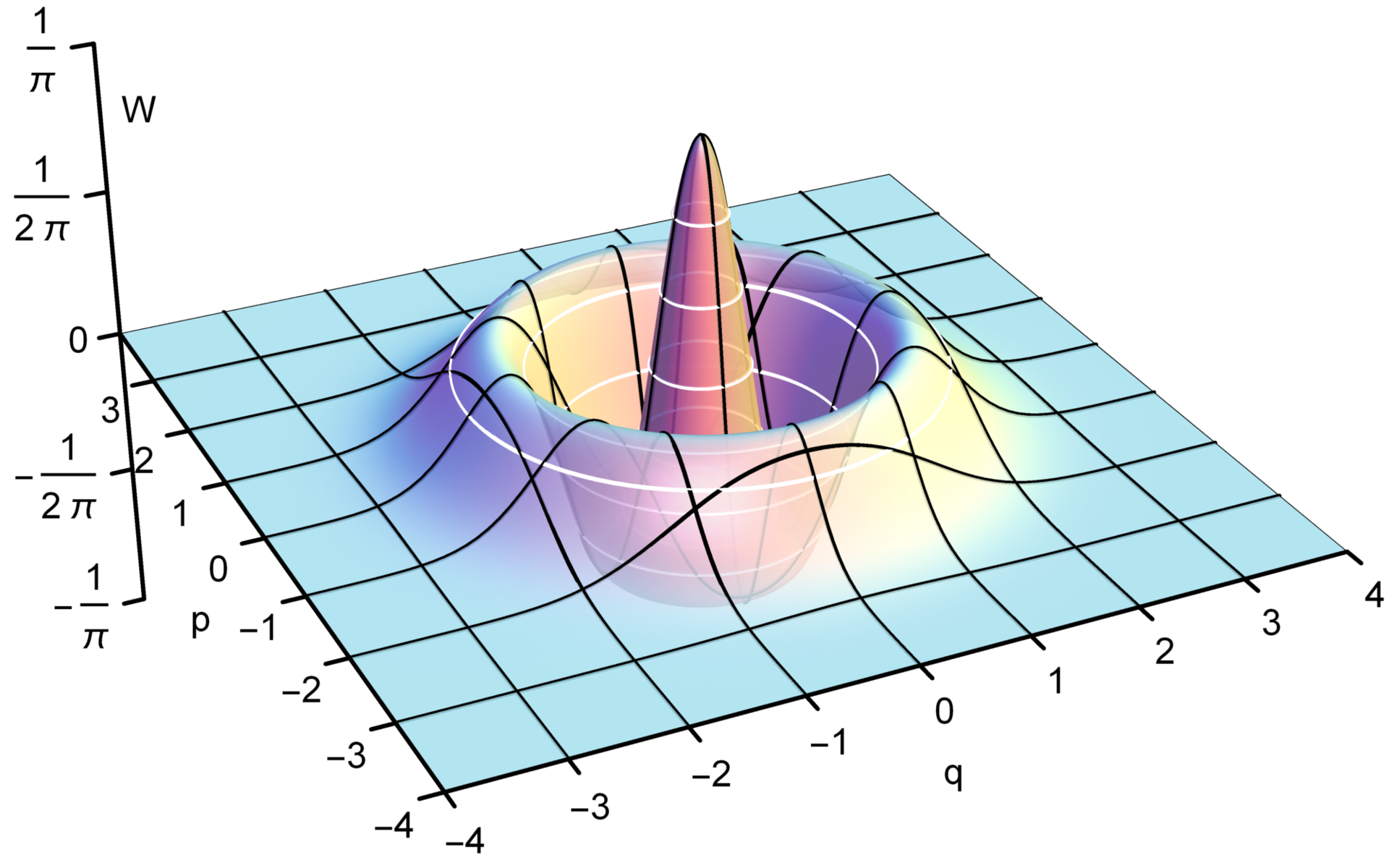
Wigner function of a Fock state with photon number n=2 (Author: Geek3, created with Mathematica).