
From Prototype to Product: Celare Quantum’s vision for QKD deployment
11 December 2025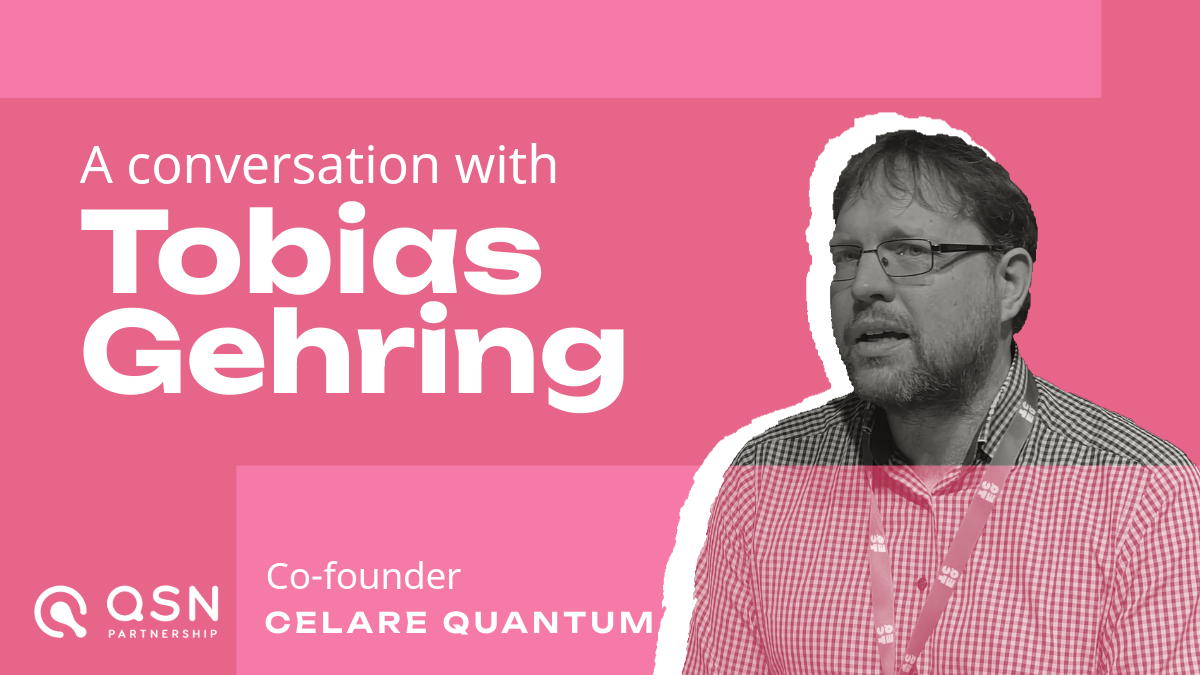
Copenhagen, Denmark. Last November at EQTC, we had the opportunity to sit down with Tobias Gehring, CEO of Celare Quantum, one of Denmark’s most promising spin-offs in the field of Quantum Key Distribution (QKD). With years of research experience and a strong drive to turn laboratory prototypes into real products, Tobias shares his view on the current state of quantum-secure communications, the rising interest from critical sectors, and how the combination of PQC and QKD will shape the future of cybersecurity.
Iñaki: We are here today with Tobias Gehring, CEO of Celare Quantum. So, Tobias, what motivated you to create this company, this is a spinoff from DTU, right?
Tobias: Yeah, so we are developing Quantum Key Distribution systems using Continuous Variable and the motivation was that I am a researcher, so I have developed these systems since around 2013, and we developed these prototypes and are using them in the Quantum communication infrastructure. And now is the time to make a product out of the prototypes. We see a clear need for Quantum Key Distribution systems as Quantum computers can break security, and QKD is a solution that cannot be broken today or in the future. It delivers future proof security, which is important for customers who have data that cannot be lost, right? Like in the government, military, telecom, finance sectors…
Iñaki: What is the reaction from these industries? Do they need really more security? Are they aware of this need of more security now and in the future?
Tobias: Yes, we see a very much increased interest in these technologies, especially in the domains I just mentioned. The awareness, I think is ever increasing. People do recognize that there is a problem and we have seen it, for example, from NATO who just required to be Quantum secure much earlier than before. So, there is also a strong demand from that.
Iñaki: What are you offering to these costumers that is new from what we have today in the industry. We have other companies in the industry, and especially in QKD systems. Are you offering something different, something new like a new approach?
Tobias: Yeah, what we are making is an enterprise network appliance that fits the needs of telecommunication companies. It fits into typical telecom racks, it operates over an extended temperature range that is needed in telecom racks, so it doesn’t need dark fibers. We can use wavelength division multiplexing fibers which reduce operational cost. So, we don’t need a dedicated fiber for our equipment.
Iñaki: What about your conversations with security officers, like CISOs and so on? You know that there are many security agencies that are promoting other options like Post-Quantum, and we are promoting QKD, which is Quantum cryptography. How do you see that they have reacted to that? Do you see that QKD is already ready for deployment or do we have to wait a little bit and go first for PQC? How has the market reacted in that sense?
Tobias: I see that as a complementary solution, PQC and QKD, which don’t solve the same problem. What we can offer is this future proof security, which is, fundamentally different to PQC. I’m always saying: yes, implement PQC because if you’re not Quantum secure at all that’s a big, big, problem. But QKD can offer something on top, right? If you’re really need this additional security, if you don’t want to believe that Post-Quantum is secure, then you can just add QKD and get that additional security.
Iñaki: So, your approach would be that we combine the best of both worlds?
Tobias: Exactly!
Iñaki: Maybe we can start with the PQC because it’s already available today and it’s only software based, and maybe easier, but then keep an eye into QKD also.
Tobias: Implementing PQC is not necessarily easier, because if you implement that in a switch, you might also need new hardware, it may require a new generation of hardware anyway. And cybersecurity solutions are exchanged every 5 to 10 years. So, if a company goes through that cycle, they can actually think of PQC or QKD already into their security concept and implement QKD as the lowest layer of defense, and then have more of the classical solutions on top and higher layers.
Iñaki: What do you think are the roadblocks for QKD to really be deployable right now and to a large scale? What is the focus that you concentrate first?
Tobias: One roadblock I see is the price of the technology, that has to go down, and at the same time volume has to go up. This is somehow connected. We have a huge focus on reducing cost and to be able to offer our solutions at a price that doesn’t stick out. If you build a secure network, you have different network components and the goal is that QKD is basically just part of this, part of that solution and not something that you have to put in a huge amount of money to get that extra security, just a similar price than the other network components.
Iñaki: What are the steps are you taking to reduce the cost?
Tobias: Well, first of all, building or using standard components that are available in the market is a first step and integrating them in the second step. We will look into photonic integration and also electronic integration.
Iñaki: Okay, so last but not least. You know that we are now in the 2025 International Year of Quantum, it’s almost gone but what is your wish for the next year, 2026 and the following years in terms of industry? How do you see the industry evolving into the next year and the following ones?
Tobias: We see a lot of interest in quantum and now what we have to do as industry is to deliver. We need to know how to deliver the products: you have to deliver them at a price that are acceptable and then I believe that we will be able to scale the technology to larger volumes.
Iñaki: Okay Tobias. Thank you very much for your time and good luck for the future with your company.
Tobias: Thank you.